





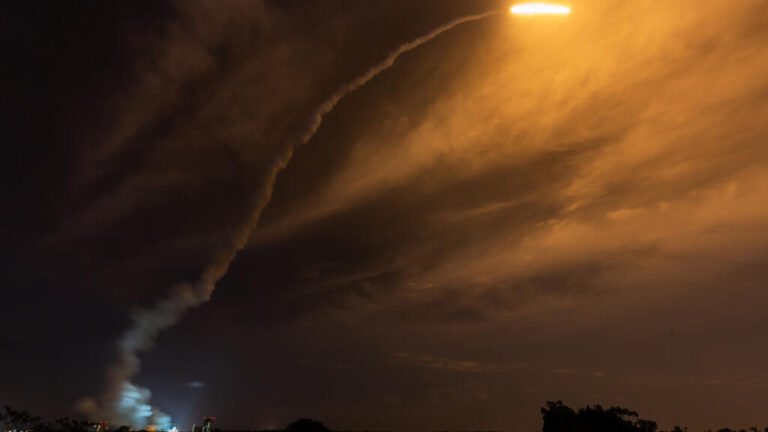

La unidad de “dinámica de vuelo ya confirmó que (la nave) logró una captura orbital alrededor de Mercurio”, informó la Agencia Espacial Europea (ESA) en X el domingo 22 de noviembre. Agregó que sus equipos estaban analizando los datos enviados por BepiColombo.
El sábado por la noche, la agencia había anunciado que BepiColombo giró según lo previsto. Más tarde informó que el encendido de sus propulsores, que debía durar 37 minutos, ya tendría que haber comenzado. La maniobra servía para frenar la nave y permitirle entrar en la órbita de Mercurio, el planeta más cercano al Sol.
La nave pesa cuatro toneladas y fue lanzada en octubre de 2018. Desde entonces recorrió más de 10.000 millones de kilómetros y pasó nueve veces cerca de otros planetas para ajustar su velocidad y su trayectoria hacia Mercurio.
We’ve heard back from Bepi – the spacecraft is now in contact with the ground and the teams at ESOC are busy assessing the telemetry. Flight Dynamics already has confirmed it achieved orbital capture around Mercury! Early next week we’ll share the next update with the upcoming steps.
— BepiColombo (@BepiColombo) November 22, 2026
Imágenes nunca vistas de Mercurio
A partir de abril de 2027, la sonda MPO (Mercury Planet Orbiter) de la ESA estudiará el planeta con una precisión sin precedentes. Pasará a apenas 480 km de su superficie.
La sonda Mio (Mercury Magnetospheric Orbiter), de la agencia espacial japonesa (JAXA), se ocupará del entorno espacial del planeta, en particular de su campo magnético. Para eso seguirá una órbita elíptica que la alejará hasta 11.000 km.
Según el plan de vuelo, las dos sondas se separarán el 9 y el 10 de diciembre para llegar cada una a su órbita.
After eight years of dancing with the Sun, a European-Japanese probe has finally slipped into orbit around Mercury. On November 21, 2026, BepiColombo — the most ambitious mission ever sent to the innermost planet — completed the hardest arrival in the Solar System. Getting to Mercury is not a matter of simply aiming and thrusting. The Sun’s gravity is a trap; fall too fast and you plunge into the star. So the spacecraft spent nearly a decade on a looping path of planetary flybys, borrowing energy from Earth, Venus, and Mercury itself, all while battling the searing heat of the inner Solar System. A thruster glitch in 2024 forced one final delay, but the wait is over. BepiColombo is not one spacecraft but two. ESA’s Mercury Planetary Orbiter (MPO) and JAXA’s Mercury Magnetospheric Orbiter (Mio) arrived still locked together. In early December they will separate into complementary polar orbits: MPO will circle low and fast to map the scorched, cratered surface, measure its composition, topography, and gravity, and probe the size of the planet’s oversized iron core. Mio will fly a higher, slower path, watching how Mercury’s weak magnetic field dances with the solar wind. Only one other mission — NASA’s MESSENGER — has ever orbited this world. BepiColombo will go deeper, answering questions MESSENGER could only raise: Why is Mercury so dense? How does a tiny planet still hold a magnetic field? What secrets hide in its permanently shadowed polar craters? The science phase begins in 2027. Until then, two orbiters are settling into the hottest neighborhood in the Solar System, ready to reveal the planet that has always been the hardest to reach — and the most reluctant to give up its mysteries.
— Black Hole (@konstructivizm) November 22, 2026
La misión debe “ofrecer a la humanidad y a la comunidad científica imágenes nunca vistas de Mercurio y abrir un nuevo capítulo en nuestra comprensión del sistema solar“, dijo a principios de este año Santa Martínez, responsable de la misión en la ESA.
En Mercurio las temperaturas van de -180 °C a 450 °C y la radiación solar es intensa. La primera nave en sobrevolarlo fue la sonda estadounidense Mariner 10, en 1974.
Con AFP